Scissor lifts & lift tables
Single, double and tandem scissors — floor mounted or pit installed, from zero-level tables to heavy-duty platforms.
ISO 9001:2008 certified · 375+ installations across India & abroad

What a hydraulic lift is, the four types we manufacture, the published capacities and travels in one table, and how to work out which machine your job actually needs.
A hydraulic lift raises a platform with oil under pressure. A pump pushes oil into one or more cylinders; the cylinders extend and the deck rises straight up, with no swing and no overhead structure. Lowering is done by metering that oil back out, so the descent stays controlled whether the deck carries fifty kilograms or five tonnes.
That simplicity is the whole appeal. There are few moving parts, the machine holds its load without consuming power, and the mechanism scales. The same principle drives a bench-height bike lift and a showroom car lift travelling eight metres. It is also why maintenance stays light: oil, hoses, pins and bushes, and a clear scissor path cover most of the routine.
Essem Engineers has designed and built hydraulic lifts in Delhi NCR for over two decades. There are 14 machine types across four families, almost all of them built to the customer’s duty rather than sold from stock, with more than 375 installations across India and abroad.
Most buying mistakes are type mistakes: a goods lift asked to do a platform's job, or a scissor table stretched into a shaft. Start with what the lift carries.
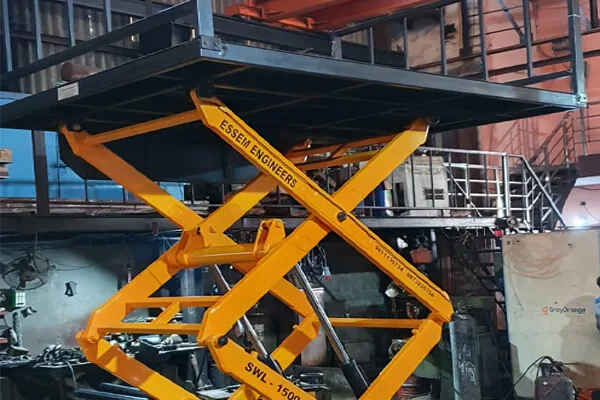
Single, double and tandem scissors — floor mounted or pit installed, from zero-level tables to heavy-duty platforms.
Towable high-rise maintenance platforms and hydraulic work platforms for safe access at height.
Car lifts, bike lifts, stackers, cantilever and dual-mast goods lifts for showrooms, plants and warehouses.
Hydraulic and traction lifts for buildings — including hole-less configurations for constrained shafts.
The published envelopes across our range. Machines built to specification carry whatever the drawing says; these are the catalogue figures.
| Machine | Capacity | Travel |
|---|---|---|
| Hydraulic Car Lift | 1000 – 6000 kg | 200 – 8000 mm |
| Cantilever Lift | approx. 2000 kg | up to 8000 mm |
| Traction Lift | 380 – 2000 kg | to suit the building, at up to 1.0 m/s |
| Hydraulic Stacker Lift | 1000 kg | 0 – 4000 mm |
| Heavy Duty Single Scissor Platform | 1000 kg | 360 – 1050 mm |
| Zero Level Lift | built to the load | raises to 2000 mm, flush with the floor |
| Two Wheeler Loading Platform | 200 kg | closed height 120 – 250 mm |
| Scissor Lift Table / Tandem / Dual Mast | built to specification | built to specification |
Boundaries are honest limits, not sales figures: a 1500 kg pallet does not belong on a 1000 kg stacker, and past 6000 kg or 8 m of travel the machine becomes a drawing-board build, which is most of what leaves our works anyway.
For building traffic the choice usually comes down to the building itself. A hydraulic elevator runs without an overhead machine room, in holed or hole-less configurations, which is what makes it work in tight shafts and retrofit structures that were never drawn with a lift in mind.
A traction lift earns its place where the building can give it a proper shaft: speeds up to 1.0 m/s and capacities from 380 to 2000 kg, with cabin finishes chosen to suit the space. Taller buildings and busier traffic lean traction; constrained structures lean hydraulic. We build both, so the recommendation follows the building rather than the brochure.
Every quotation we write starts from the same five answers. They are also exactly what our lift finder asks:
Most of what we build is made to order. Share your application and our engineers will come back with a configuration, a capacity and a price.